Upper Limb Orthopaedic Anatomy
Feb 09, 2026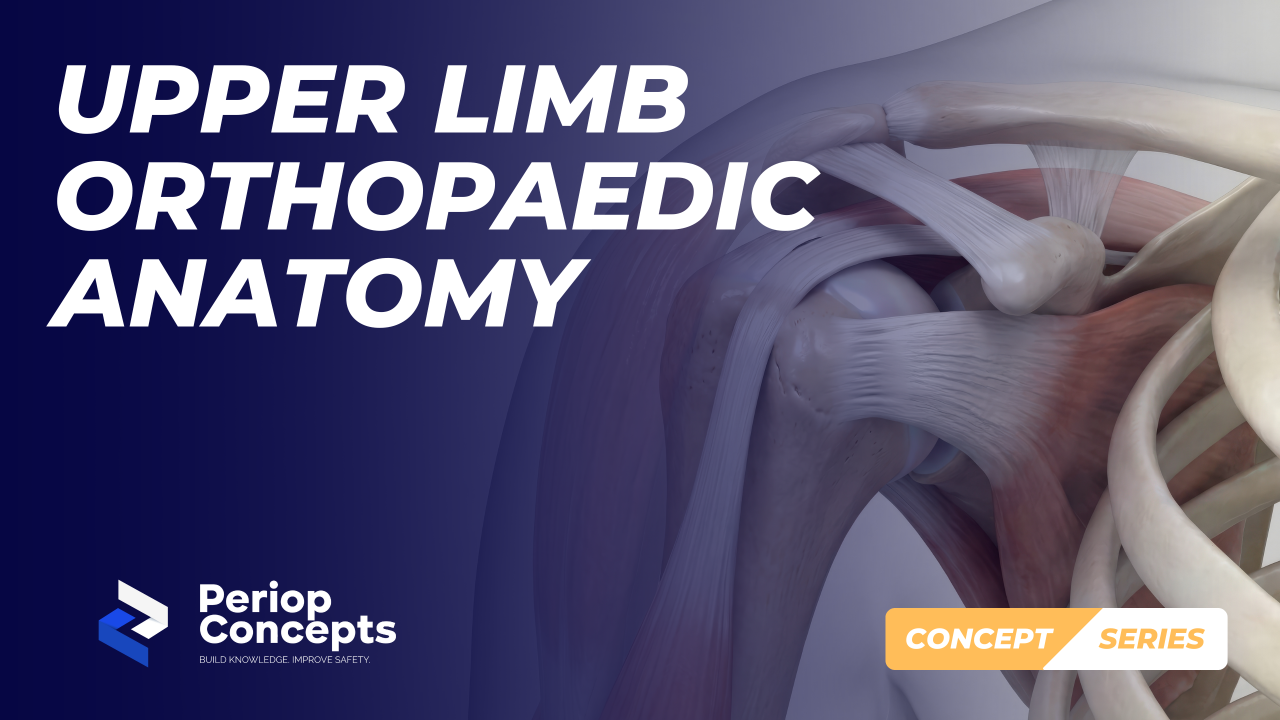
Upper limb orthopaedic surgery brings anatomy very close to the surface. Bones, nerves, vessels and tendons often sit within millimetres of each other, particularly in trauma cases. For scrub scout nurses, recognising key anatomical names and landmarks supports safer assistance and clearer anticipation throughout the procedure.
The shoulder complex includes the clavicle, scapula and proximal humerus. Surgical approaches often relate to the acromion, coracoid process and glenoid, with the rotator cuff tendons providing dynamic stability. Important neurovascular structures pass anteriorly and inferiorly, making controlled retraction essential.
At the elbow, the distal humerus articulates with the ulna and radius. Landmarks such as the medial and lateral epicondyles, olecranon and radial head guide exposure and fixation. The ulnar nerve lies close to the medial epicondyle, while the radial nerve crosses the lateral aspect of the joint, increasing risk during trauma surgery.
The forearm consists of the radius and ulna linked by the interosseous membrane, allowing pronation and supination. Distally, the wrist is formed by the distal radius, ulna and carpal bones. Tendons pass through defined compartments, and nerves travel close to bony landmarks used during plating and screw placement.
Key anatomical considerations scrub scout nurses commonly support include:
🦴 Identification of bony landmarks used for incision and fixation
🦴 Awareness of radial, ulnar and median nerve pathways
🦴 Recognition of tendon locations during exposure and repair
🦴 Understanding how swelling and positioning alter landmarks
In practice, this anatomical clarity supports safer retraction, accurate instrument readiness and timely anticipation of implants and imaging.
Knowing the names and landmarks beneath the incision strengthens confidence and protects function in upper limb surgery.
References
Surgical Anatomy of the Upper Limb. (n.d.). Upper limb. https://surgery.gr/e-books/Surgical_Anatomy/13_Upper_limb.pdf
Key anatomy points scrub scout nurses commonly support include:
🦴 Long bones such as the humerus, radius and ulna are frequent fixation sites
🦴 Joint surfaces must be protected during retraction and drilling
🦴 Tendons and nerves often sit close to surgical landmarks
🦴 Swelling or positioning can alter anatomical relationships
In practice, understanding anatomy supports smoother set up, safer retraction choices, and quicker anticipation of implants or instruments. It also strengthens communication with the surgeon during critical moments.
Strong anatomical knowledge builds confidence. When you know what sits beneath the incision, you are better placed to protect it.
References
National Center for Biotechnology Information. (n.d.). Upper Limb Anatomy. https://www.ncbi.nlm.nih.gov/books/NBK507841/
Stay connected with news and updates!
Join our mailing list to receive the latest news and updates from our team.
Don't worry, your information will not be shared.
We hate SPAM. We will never sell your information, for any reason.